
Suitability Assessment · 4 September 2026 · 4 min read
Why Does Corneal Thickness Matter?
Corneal thickness is a key factor in deciding which laser eye surgery method — PRK, Femto LASIK or SMILE — can be used, since all three remove corneal tissue and enough must remain. It is measured with pachymetry and assessed with the refractive error. If thickness falls short, glasses or contact lenses are offered instead.
Written by Op. Dr. Anıl Kaya

Almost anyone researching laser eye surgery runs into one term sooner or later: corneal thickness. Which method can be used — or whether laser is suitable at all — largely depends on this single measurement. So why does it matter so much?
What Does Corneal Thickness Actually Do?
All three laser methods (PRK, Femto LASIK, SMILE) remove or reshape some corneal tissue. Whatever remains afterwards has to stay strong enough to withstand the eye's internal pressure, so the thicker the cornea to start with, the greater the safety margin left once tissue is removed. Thickness isn't judged alone, either — the amount of tissue that needs removing also depends on the degree of your refractive error, so two corneas of the same thickness can lead to different conclusions. Correcting a high prescription removes more tissue than a low one, so a given thickness might be comfortably suitable at a low prescription yet fall short at a very high one.
How Much Thickness Does Each Method Need?
Each method reaches the cornea differently, so thickness requirements differ too. PRK makes no incision into the cornea at all (incision/flap depth: 0 mm); the laser is applied directly to the surface, so most corneal tissue is preserved, making PRK relatively flexible for a thin cornea. The epithelium regrows within a few days, leaving the remaining tissue underneath undisturbed throughout. Femto LASIK instead creates a flap roughly 9 mm across, which uses up part of the corneal thickness, so enough tissue must remain beneath it. SMILE's incision is only around 3 mm wide, leaving most of the corneal surface untouched — a middle ground in incision size, though the cornea's structure still has to meet SMILE's own criteria. A smaller incision also means more of the surface stays intact, which some see as an advantage for long-term corneal biomechanics.
Does a Thin Cornea Point Towards PRK?
In borderline cases, flap-free PRK is usually the first option considered, since it doesn't rely on the tissue a flap would use. Patients previously told elsewhere that Femto LASIK wasn't suitable because of corneal thickness can therefore be reassessed for PRK. That doesn't mean PRK suits every thin cornea, though — if the cornea is excessively thin or irregular, no method may be safely recommended, and that boundary can only be set with detailed measurements. The assessment also weighs a history of dry eye and day-to-day visual needs, which is why two patients with identical corneal thickness can end up with different recommended methods.
How Is Corneal Thickness Measured?
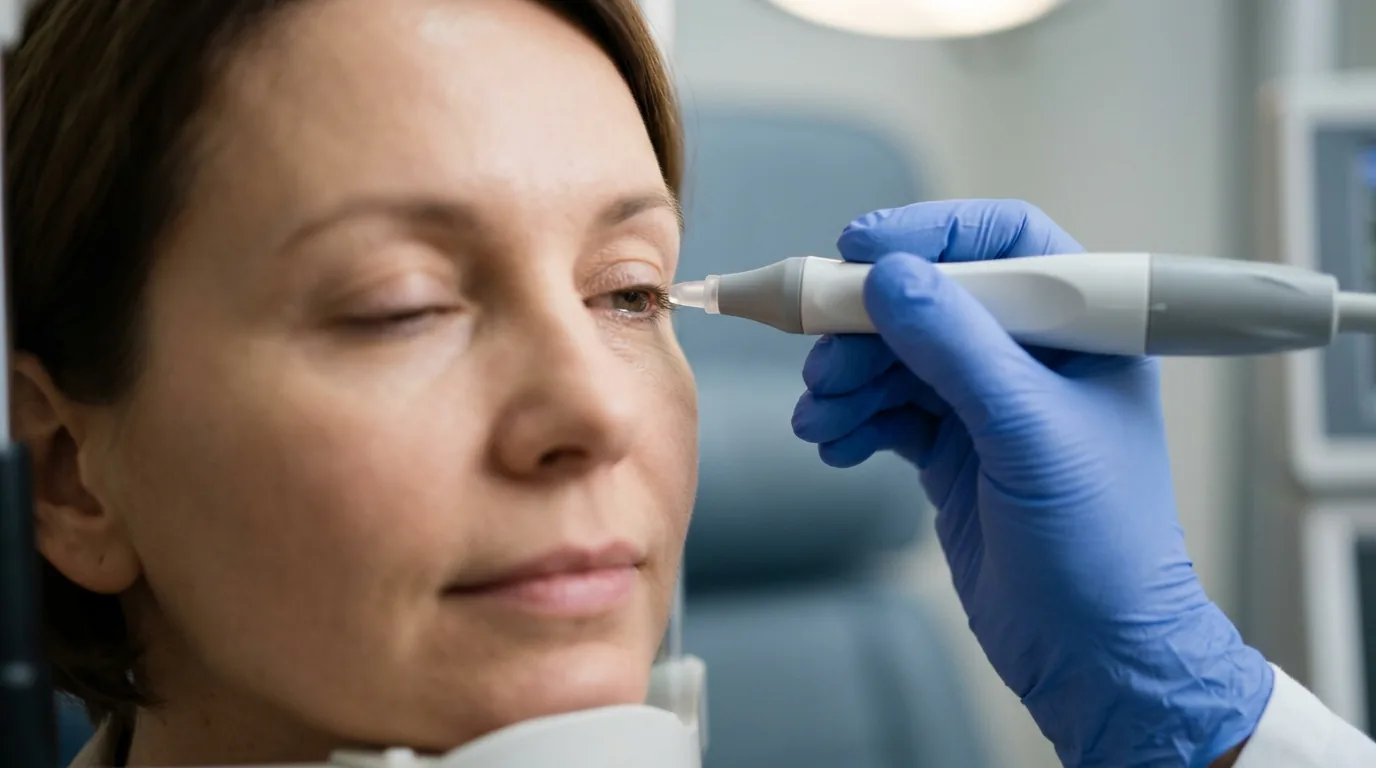
Corneal thickness is measured with pachymetry, a quick, comfortable test that causes no discomfort and takes only minutes, with results available the same day. Corneal topography is done alongside it, mapping the surface's curvature to show whether it's regular or irregular. Together, the two give a clear picture of which method can be safely applied and are a standard part of the laser suitability assessment, both completed comfortably in a single appointment. Contact lens wearers may be asked to leave their lenses out beforehand, since lenses can temporarily alter the cornea's natural curvature and skew the results.
What Happens If Thickness Falls Short?
If the cornea isn't suitable for any laser method, glasses or contact lenses remain a safe, effective alternative. Sometimes thickness allows one method — usually PRK — while ruling out the other two; that narrows the choice rather than ruling laser out altogether. A final decision only becomes clear after a detailed examination and decision support on which method, if any, suits you.
Does Corneal Thickness Change With Age?
Unlike your glasses prescription, corneal thickness doesn't change markedly with age, so a single measurement is usually a reliable reference point. Long-term habits such as eye rubbing, or a rare progressive disease called keratoconus, can affect corneal structure over time, though. If topography shows a noticeable change, it's assessed separately and carefully, and might point towards a different treatment approach. A mild corneal irregularity that had gone unnoticed can also come to light for the first time during a laser suitability assessment — one more reason this check is a step worth never skipping.
For more detail on this topic, see Laser Eye Surgery in our ecosystem, covering corneal suitability for PRK, Femto LASIK and SMILE
Related Pages
References
- Calculation for LASIK Ablation — American Academy of Ophthalmology — EyeWiki, 2026
- Photorefractive Keratectomy — American Academy of Ophthalmology — EyeWiki, 2026
Send your appointment request to Op. Dr. Anıl Kaya
There are two ways to ask about your eye health or request an appointment. If you would like the doctor to know your situation before replying, complete the short assessment first; if your question is brief, fill in the form alongside. Both reach the same team.
Your age and a short sentence are enough; no medical terms needed. What you write is only sent when you send it; this page stores no information.