
What Is a Laser Suitability Assessment?
One visit measures corneal thickness, topography, dry eye, eye pressure and the back of the eye, with results shared the same day. Book your assessment in Istanbul.


A laser suitability assessment is the pre-operative eye examination used to decide whether laser eye surgery is safe, and which method suits the patient, before any procedure is planned. It measures corneal thickness, topography, dry eye levels, eye pressure and the back of the eye, completed in one visit with same-day results.
Written by Op. Dr. Anıl Kaya
What Is a Laser Suitability Assessment?
A laser suitability assessment is the pre-operative examination of corneal structure, prescription stability and overall eye health for patients considering laser eye surgery. It should not be skipped before any laser method is chosen, because these measurements show which method can be used safely, or whether laser treatment is not appropriate at this time. The assessment is completed in a single visit, with results discussed the same day, and it also helps establish which method actually suits the patient.
Where does a laser suitability assessment sit in the decision process?
What Does a Laser Suitability Assessment Check?
This assessment looks at several parameters: corneal thickness, corneal curvature mapping (topography), the level of dry eye, intraocular pressure and the health of the back of the eye. Together, these show which laser method can be used safely, or when laser treatment is not suitable for now. Corneal thickness shows how much tissue can safely be removed, topography shows whether the cornea's shape is regular, dry eye levels indicate how healing may progress, and intraocular pressure with the back of the eye rule out other eye conditions. Together, the results give a clear picture of the suitable method and risks.
Corneal thickness (pachymetry)
Sets the safe limit for how much tissue can be removed with laser.
Corneal topography
Maps the cornea's curvature to show whether it is regular or irregular.
Level of dry eye
Gives an indication of how the healing process may progress.
Intraocular pressure and the back of the eye
Checks for any other eye condition unrelated to laser treatment.
Who Should Have a Laser Suitability Assessment?
Anyone who wants to see clearly without glasses or contact lenses, has been diagnosed with myopia, hyperopia or astigmatism, and whose prescription has been stable for some time can have this assessment, the only reliable way to establish whether laser treatment is suitable. Patients previously told by another doctor that they were not suitable can request a second opinion using current measurement techniques. In patients under eighteen, the assessment is usually postponed because the prescription has not yet stabilised; stability is followed through measurement, not age. A final decision is only made once these measurements are complete.
When Is a Laser Suitability Assessment Needed?
For patients who find distance vision blurred and are considering life without glasses, this assessment is the first step, clarifying the type and degree of the refractive error behind the complaint. It is also a reliable starting point for those who believe their prescription has not changed in a year or two but want this confirmed by measurement. Patients tired of wearing glasses or contact lenses, or for whom sport or work makes glasses-free vision a priority, will find this the first concrete step too. Neither the duration nor severity of these complaints changes the recommendation to be assessed.
How Is a Laser Suitability Assessment Done?
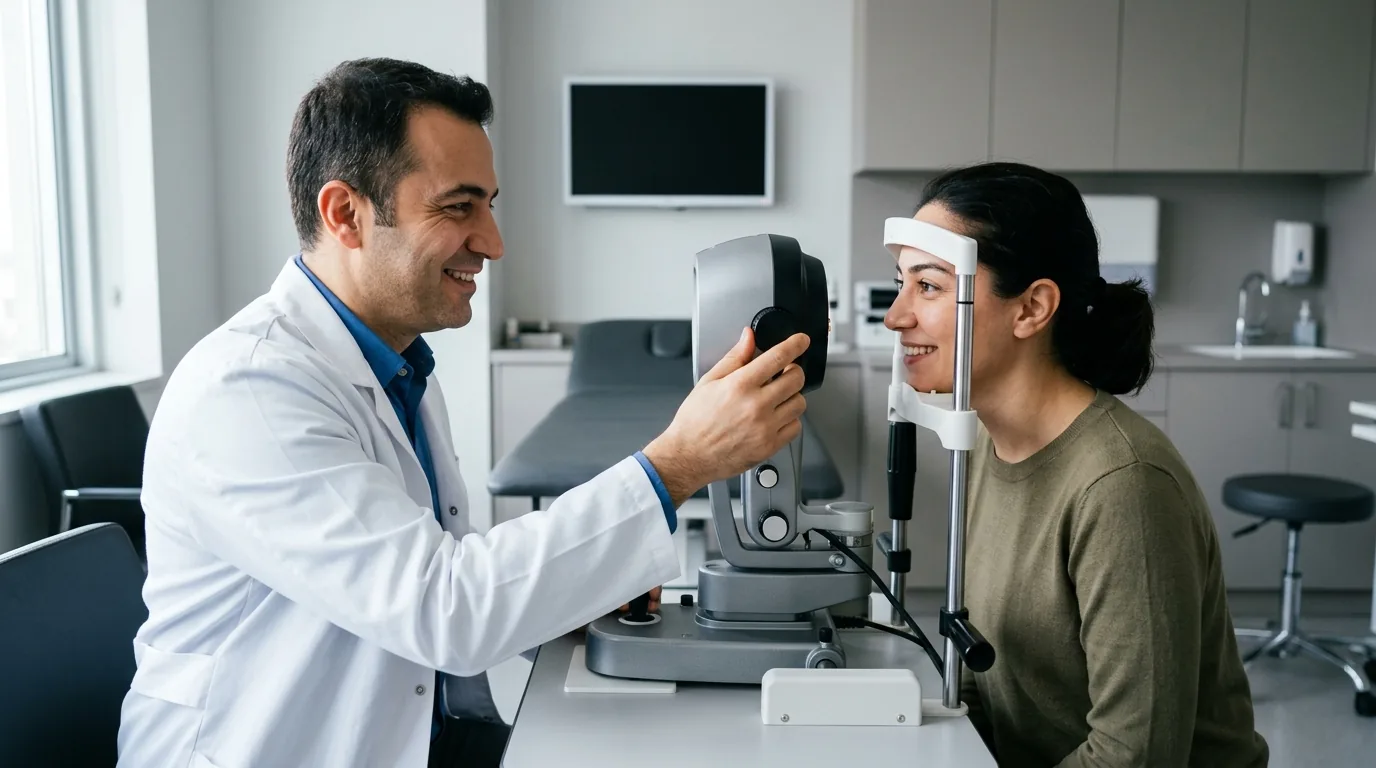
The assessment includes visual acuity testing, corneal topography (imaging that maps the curvature of the corneal surface), corneal thickness measurement (pachymetry), intraocular pressure measurement, and a dilated fundus examination. Tests assessing tear production may be added, since dry eye levels can influence which method suits better. Contact lens wearers may be asked to leave their lenses out beforehand, usually a few days for soft lenses and longer for rigid ones, since lenses can temporarily change the cornea's natural curvature and skew the results. All the data is then reviewed together to decide which laser method can be used safely, or whether laser treatment is not suitable for now, in a single appointment, without discomfort.
- 1Visual acuity test. Measures your current prescription and clarity of vision.
- 2Corneal topography. Produces a detailed curvature map of the corneal surface.
- 3Pachymetry. Precisely measures corneal thickness.
- 4Intraocular pressure and fundus examination. Checks the health of the back of the eye with the pupil dilated.
What Do the Results of a Laser Suitability Assessment Mean?
If the cornea is thick enough and regular, one of TransPRK (no-touch PRK), Femto LASIK or SMILE may be recommended depending on the patient's refractive error; if it is thin or irregular, a different option may be considered instead of laser, and outcomes vary between patients. The decision weighs not just an absolute thickness figure but also the amount of tissue that removing the refractive error would require, so two corneas of the same thickness can lead to different outcomes. The chart below gives a simplified view of how corneal thickness compares with average values. The result is not simply yes or no, so the report is reviewed with the patient in detail.
Where does corneal thickness sit compared with average values?
What Findings Can a Laser Suitability Assessment Reveal?
This assessment establishes the degree of refractive errors such as myopia, hyperopia and astigmatism, and can sometimes identify an accompanying condition such as dry eye, included in the treatment plan. Rarely, a progressive corneal condition such as keratoconus that had not previously been noticed may come to light for the first time; a different treatment approach is then considered instead of laser surgery. Identified dry eye disease may be treated first to help the overall outcome, and raised intraocular pressure is assessed separately and, if needed, addressed before any decision on laser treatment.
How often does each finding appear at the assessment?
Which Treatment Options Does a Laser Suitability Assessment Consider?
If the refractive error is suitable for laser treatment, one of TransPRK, Femto LASIK or SMILE (KLEx) is recommended; if the corneal structure is not, alternative options are considered. Baseline checks from a general eye examination may also be included. Which option stands out depends not only on the refractive error but also on corneal thickness and structure, so the choice between the three methods is assessed individually. If the corneal structure suits no laser method, glasses or contact lenses remain a safe and effective alternative.
Frequently Asked Questions
How long does a laser suitability assessment take?
It is usually completed in a single visit, though contact lens wearers may be asked to stop wearing their lenses for a period beforehand for some of the tests.
Is the assessment uncomfortable?
No, the tests used generally do not cause discomfort, although eye drops may be used for some of them.
What happens if laser surgery is not found suitable?
If the corneal structure is not suitable for laser treatment, the doctor considers other treatment options instead.
Does the assessment involve any discomfort?
No, none of the measurements cause discomfort; some tests may involve a brief puff of air or the sensation of eye drops.
Are the results explained straight away?
Yes, the measurements taken at the assessment are reviewed the same day, and the patient is told which method is suitable, or that laser treatment is not recommended for now.
References
- The frequency of non-pathologically thin corneas in young healthy adults — Clinical Ophthalmology (PMC), 2019
- Risk assessment for ectasia after corneal refractive surgery — Ophthalmology (Europe PMC), 2008
Booking Your Assessment
To book a laser suitability assessment, contact Op. Dr. Anıl Kaya's clinic in Istanbul through the contact page. Contact lens wearers should ask, when they get in touch, how long before the appointment to stop wearing their lenses so the measurements are accurate. Your current glasses prescription, any previous eye examination records and your general medical history will also be noted at your first visit.
Find the Right Path for You
There are many different conditions and options in this area — browse by topic below, or answer a few questions to see the step closest to your situation.
Explore by Topic
The Basics
4 pagesDiagnosis & Methods
1 pageComparisons
3 pagesDecision Support
1 pageFind What Suits You
Laser Eye Surgery RoadmapA few questions, the right next step for you
Ophthalmologist · Kartal, Istanbul
Why Op. Dr. Anıl Kaya?
Related Pages
Would you like to contact the doctor with a Laser assessment tailored to you?
There are two ways. If you would like the doctor to know your situation before replying, complete the Laser Roadmap first; if your question is short, write directly. Both reach the same team.
Your age and a short sentence are enough; no medical terms needed. What you write is only sent when you send it; this page stores no information.