
What Is Femto LASIK?
Femto LASIK creates a thin corneal flap with a femtosecond laser, and vision usually clears within the first day. See the risks, then check your suitability in Istanbul.


Femto LASIK is a laser eye surgery technique in which a femtosecond laser creates a thin corneal flap, lifts it so an excimer laser can reshape the tissue beneath, then repositions the flap. Vision typically sharpens within the first day. It corrects myopia, hyperopia and astigmatism.
Written by Op. Dr. Anıl Kaya
What Is Femto LASIK?
Femto LASIK is a laser vision correction technique in which a femtosecond laser first creates a thin corneal flap, lifts it so a laser can treat the tissue underneath, then lays it back into place. It is the most widely performed flap-based technique in laser eye surgery, used in millions of eyes worldwide over several decades. The femtosecond laser shapes the flap with precise, computer-controlled light pulses rather than a mechanical blade, keeping its thickness and shape consistent. Once lifted, an excimer laser reshapes a calculated amount of the underlying tissue (the stroma) so light focuses more clearly on the retina; the flap then adheres naturally as healing begins.
How is the flap created and repositioned in Femto LASIK?
Which Treatment Does Femto LASIK Belong To?
Femto LASIK is one of three main laser eye surgery techniques, used to correct myopia, hyperopia and astigmatism. PRK, Femto LASIK and SMILE reach the same goal by different routes, differing in how the laser reaches the cornea, whether a flap is created, and how healing unfolds. Femto LASIK's key difference is that, thanks to the flap, vision typically sharpens within the first day. The right technique is decided during examination, weighing corneal thickness, topography and lifestyle together; detailed comparisons are covered in separate articles.
Who Is a Candidate for Femto LASIK?
Femto LASIK may be considered for patients with adequate corneal thickness, no significant dry eye, and a preference for a short recovery. Because a flap is created, corneal thickness must be above a certain threshold, confirmed during examination through topography and pachymetry. The profiles below are commonly seen in Femto LASIK assessments, though final suitability is confirmed only after examination. Stable eye health with no irregular corneal curvature is a reasonable starting point. In pregnancy or breastfeeding, the procedure may be postponed, as hormonal changes can temporarily affect visual sharpness.
Adequate corneal thickness
Creating a flap requires sufficient corneal tissue thickness, which is measured during examination.
Prioritising faster visual recovery
Thanks to the flap, vision typically becomes noticeably sharper within the first day.
No significant history of dry eye
Since cutting the flap can affect corneal nerve endings, any history of dry eye is assessed separately during examination.
Able to attend regular follow-up visits
The healing process requires using prescribed drops and keeping follow-up appointments.
How Is Femto LASIK Performed?
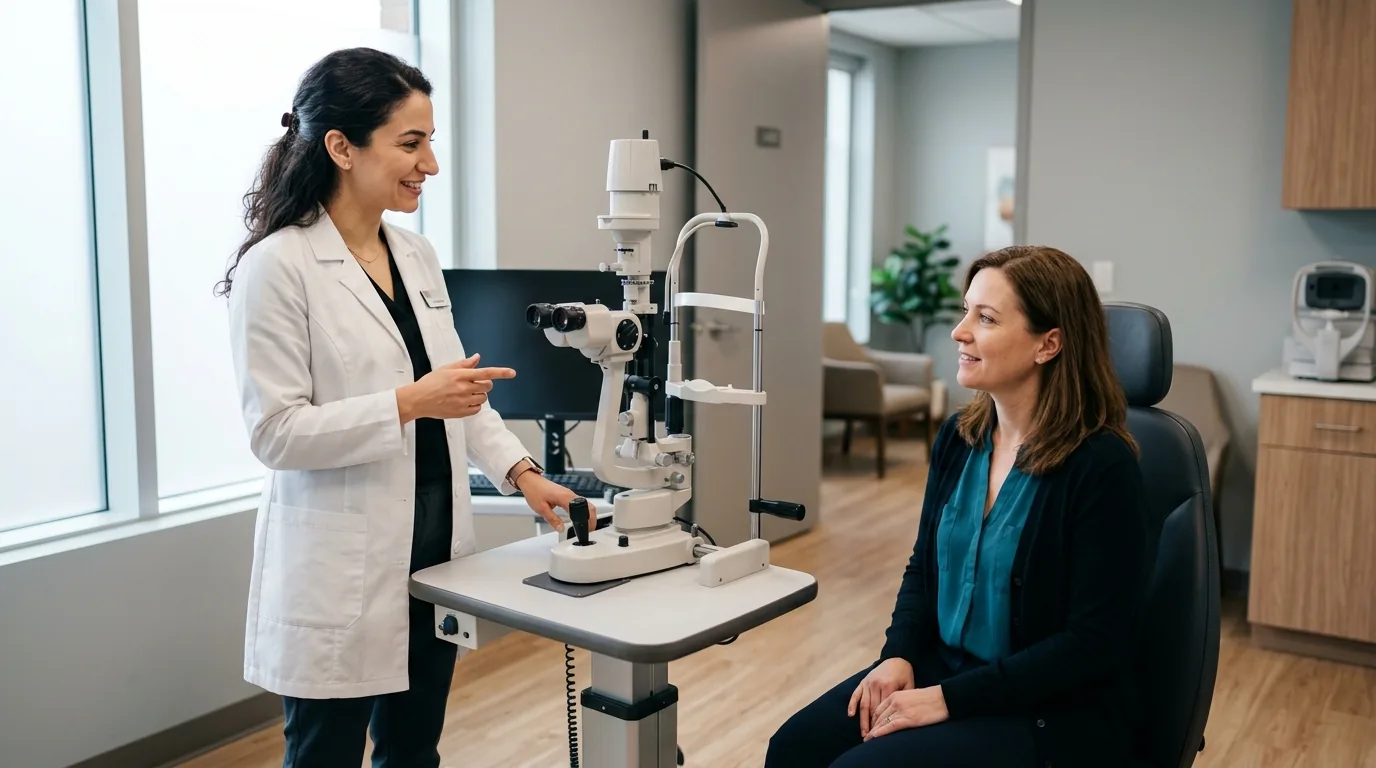
Before the procedure, the eye is numbed with anaesthetic drops so no pain is felt. A femtosecond laser creates a thin flap, roughly 100-120 microns thick, in the upper cornea, leaving a hinge so it can be lifted. An excimer laser then reshapes a calculated amount of the underlying tissue (the stroma). The flap is laid back into place and adheres naturally, with no stitches required. The procedure is quick for a single eye, and patients can usually go home the same day.
- 1Anaesthetic drops. The surface of the eye is numbed with drops, so no pain is felt.
- 2Femtosecond laser creates the flap. Precise pulses of light create a thin, hinged flap in the upper layer of the cornea.
- 3Excimer laser reshaping of the stroma. A personally calculated amount of the underlying corneal tissue is reshaped.
- 4The flap is repositioned. The flap is laid back into place and adheres naturally, with no stitches needed.
What Are the Advantages and Limitations of Femto LASIK?
Femto LASIK's advantage is that, thanks to the flap, vision typically sharpens quickly, with less discomfort in the first few days than PRK. Its limitation is that a flap may not suit thin corneas or certain eye structures; the flap uses part of the corneal thickness, and the remaining tissue must be enough for the laser treatment itself. The chart below shows the flap's thickness relative to average corneal thickness, which is why PRK may be considered instead when thickness is borderline.
How much of the cornea does the flap use?
What Is the Recovery Process After Femto LASIK?
Most patients notice a marked improvement in vision within the first day; mild stinging and watering usually ease within a few days. Full visual stability can take several weeks and varies by patient. Because a flap is used, the epithelium heals faster than with PRK, so most patients return to daily activities sooner. Since the flap stays vulnerable to impact in the early days, it is important to avoid activities that risk eye contact for as long as advised. Follow-up visits are usually set at the first day, one week and one month, to confirm the flap is healing well.
What Are the Risks of Femto LASIK?
Risks include rare flap-related complications (wrinkling or displacement), temporary dry eye, infection risk, and a visual outcome that differs from what was expected. These are uncommon but discussed in detail during examination. Because the flap stays vulnerable to impact in the early days, certain precautions are needed during recovery; using prescribed drops consistently and keeping follow-up appointments help catch complications early. Rarely, a temporary wrinkle at the flap edge or a fine fold underneath can occur, usually noticed and corrected early. Light sensitivity and temporary night-time halos or glare are also reported by some patients in the first few weeks, easing over time.
How often do risks and side effects occur with Femto LASIK?
What Are the Alternatives to Femto LASIK?
TransPRK (no-touch PRK) and SMILE (KLEx) can be considered as alternatives to Femto LASIK. The suitable technique depends on corneal structure, dry eye history, and personal priorities. In borderline corneal thickness, flapless TransPRK may be preferred, while SMILE, working through a smaller incision, offers a different balance; detailed comparisons are covered in separate articles. Refractive error type and degree also influence the choice; myopia, hyperopia and astigmatism are each covered in their own articles.
| PRK | Femto LASIK | SMILE | |
|---|---|---|---|
| No flap is created | ✓ | — | ✓ |
| Used for hyperopia | ✓ | ✓ | — |
How Does Femto LASIK Compare With Other Techniques?
How Femto LASIK compares with PRK and SMILE - recovery time, how the first few days feel, and flap-related differences - is covered in separate comparison articles. A general overview of which technique may suit you is in the laser eye suitability examination and technique decision guide. For borderline corneal thickness, or higher risk of eye contact in daily life, the difference between PRK and Femto LASIK should be reviewed before a final decision.
Frequently Asked Questions
How long does it take to recover after Femto LASIK?
Most patients notice a marked improvement in vision within the first day, though full recovery can take a few weeks.
Is there a risk of the flap slipping after Femto LASIK?
This is a rare occurrence; following the doctor's advice, such as avoiding rubbing the eye, helps reduce this risk.
Can Femto LASIK be used for any degree of myopia?
No, if corneal thickness is insufficient in cases of very high myopia, a different technique may be recommended.
What is the main difference between Femto LASIK and PRK?
In Femto LASIK, a thin flap is lifted first, whereas PRK does not involve a flap and the laser is applied directly to the corneal surface. This difference affects the recovery process and, for some patients, which technique is chosen.
When can I go back to work after Femto LASIK?
Vision becomes noticeably sharper within the first day for most patients; the time it takes to return to work varies from person to person and depends on how much contact risk the job carries for the eyes, which is assessed at follow-up.
References
- LASIK — Laser Eye Surgery — American Academy of Ophthalmology (AAO), 2026
- Questions to Ask When Considering LASIK — American Academy of Ophthalmology (AAO), 2023
Appointment
To find out whether Femto LASIK suits you, request an appointment at Op. Dr. Anıl Kaya's practice in Istanbul through the contact page. During examination, your corneal thickness, topography and prescription are assessed together to identify the most suitable technique. The first visit also covers your dry eye history and daily habits.
Find the Right Path for You
There are many different conditions and options in this area — browse by topic below, or answer a few questions to see the step closest to your situation.
Explore by Topic
The Basics
4 pagesDiagnosis & Methods
1 pageComparisons
3 pagesDecision Support
1 pageFind What Suits You
Laser Eye Surgery RoadmapA few questions, the right next step for you
Ophthalmologist · Kartal, Istanbul
Why Op. Dr. Anıl Kaya?
Related Pages
Would you like to contact the doctor with a Laser assessment tailored to you?
There are two ways. If you would like the doctor to know your situation before replying, complete the Laser Roadmap first; if your question is short, write directly. Both reach the same team.
Your age and a short sentence are enough; no medical terms needed. What you write is only sent when you send it; this page stores no information.