
How Is a Glasses Prescription Measured? The Refraction Test
A refraction test measures your glasses prescription: an autorefractor gives an estimate, then a phoropter fine-tunes it with your feedback. Book an eye test in Istanbul.
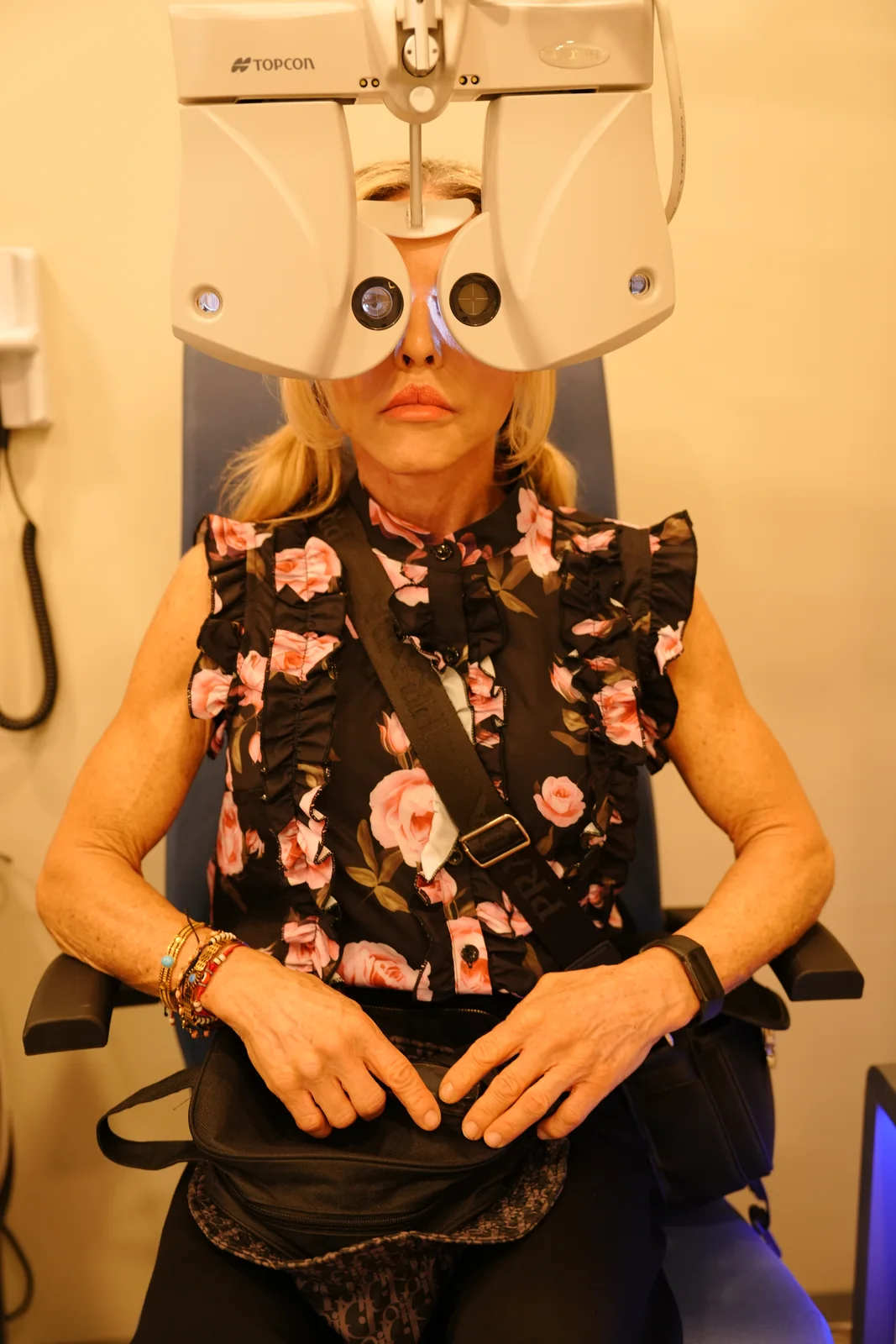

A glasses prescription is measured with a refraction test, which shows the optical correction your eye needs to see clearly — the degree of myopia, hyperopia or astigmatism. An autorefractor gives an initial estimate, then a phoropter fine-tunes the result using your feedback, without any discomfort to the patient.
Written by Op. Dr. Anıl Kaya
What Is a Refraction Test?
A refraction test — the clinical term for what most patients call a glasses prescription check — shows whether the eye focuses light sharply on the retina and, if not, the size and direction of the error. It quantifies any refractive error, such as myopia, hyperopia or astigmatism, and forms the basis of a glasses or contact lens prescription. The test covers only optical power; a fundus examination, an intraocular pressure check (glaucoma screening) and a front-of-eye assessment are separate items, usually done at the same appointment. It can also be booked alone for patients who simply need a prescription renewed.
Quick Facts
A refraction test measures the eye's refractive error in dioptres without discomfort, usually within minutes. It starts with an autorefractor reading, then is fine-tuned on the phoropter using the patient's feedback. Myopia, hyperopia and astigmatism are identified this way, and the result forms the basis for a prescription; final suitability is confirmed at the doctor's examination.
What Does a Refraction Test Assess?
The test shows how clearly each eye sees alone and together, identifying the type (myopia, hyperopia or astigmatism) and degree of any refractive error. Distance and near vision are assessed separately where needed; some patients see well at distance but struggle up close, or the reverse, a gap often more noticeable with age-related changes such as presbyopia. Any difference in refractive power between the two eyes is also noted, since it can affect lens centring and how easily the patient adapts to new glasses.
Who Should Have a Refraction Test?
Anyone noticing blurred distance or near vision, anyone whose prescription may have changed, children and adults needing glasses for the first time, and patients wanting a suitability check before laser eye surgery should have this test. As a child's eyes develop quickly, an annual check is generally recommended for school-age children; in young adults aged 18-40, the prescription usually changes more slowly, so roughly every two years is often enough. Between 40 and 65, an annual check is again advisable, as near vision can shift with presbyopia; over 65, cataracts and other age-related changes can affect it more, so a check roughly every six months may be more appropriate. These intervals are general guidance; an examination can always be arranged sooner if symptoms appear.
Recommended Check-up Frequency by Age Group
Which Symptoms Call for a Refraction Test?
Difficulty reading distant signs or nearby text, a habit of squinting, and blurry vision with headaches are reasons to prioritise this test. Eye strain during long screen use, lines that seem to blur together while reading, and halos around lights when driving at night can also point to a refractive error. In children, sitting very close to the television or the board, skipping lines while reading, and covering one eye are behaviours parents should follow up on.
How Is a Refraction Test Performed?
The test is carried out by showing the patient a chart of letters or symbols in different sizes while trying out a series of lenses. It starts with an autorefractor, which automatically measures an approximate refractive value within seconds, giving the next step a starting point. Op. Dr. Anıl Kaya then uses a phoropter — an instrument holding a rotating set of lenses — showing a sequence of combinations and asking which looks clearer, fine-tuning the result from that feedback. A wall chart is used for distance vision and a hand-held card for near vision; any notable difference between the two is noted. If astigmatism is suspected, cylindrical lenses are added to work out its axis and degree. When needed, the pupillary distance between the pupils is measured in millimetres so new lenses can be centred correctly. In children, or in adults where the eye's own focusing effort might skew the result, cycloplegic drops temporarily relax this reflex for a more reliable reading; some blurring of near vision and light sensitivity for a few hours afterwards is normal in that case. The procedure involves no discomfort and usually takes a few minutes; contact lens wearers are advised to remove their lenses beforehand.
- 1Autorefractor reading. The device automatically measures an approximate refractive value within seconds, giving a starting point for the next step.
- 2Fine-tuning with the phoropter. Op. Dr. Anıl Kaya shows a series of lens combinations and refines the result using the patient's feedback.
- 3Comparing distance and near vision. A wall chart and a hand-held reading card are used to check for any difference between the two distances.
- 4Cylindrical measurement for astigmatism. If astigmatism is suspected, cylindrical lenses are added to determine its axis and degree.
- 5Cycloplegic confirmation if needed. In children, or in some adults, eye drops are used to temporarily relax the eye's focusing reflex for a more reliable result.
What Do the Results Mean?
The resulting prescription shows the optical correction your eye needs to see clearly, expressed in dioptres. A negative value means myopia, a positive value hyperopia, and a cylindrical value astigmatism; the accompanying axis, a number between 0 and 180, describes its orientation. When the prescription differs noticeably between the two eyes, the lenses must be prepared separately to match. If your prescription has changed markedly since the last check, or keeps increasing over short intervals, the doctor may suggest further assessment; a rapid, asymmetric increase in one eye is worth watching closely. After the test, the patient receives a written prescription showing the spherical value for each eye, the cylindrical value and axis where relevant, and the pupillary distance if needed. A prescription is generally valid for a limited period, since refractive error can change over time, so an up-to-date test is advisable before ordering new glasses or lenses from an old one.
Which Conditions Can a Refraction Test Identify?
The conditions most commonly identified are myopia, hyperopia and astigmatism, usually stemming from small variations in eyeball length, corneal curve, or lens power. After 40, presbyopia — an age-related difficulty focusing up close — is often added and can create a separate need for reading glasses, independent of the distance prescription. More rarely, an unexpected, rapid change in one eye, or marked asymmetry between the two eyes, can point to conditions affecting the cornea's structure, such as keratoconus, investigated further with additional imaging. Refractive errors are covered in more detail within our laser eye surgery section.
Refractive Errors by Frequency
What Are the Treatment Options After a Refraction Test?
When a refractive error is identified, glasses or contact lenses are the most common solution; the choice depends on lifestyle, occupation and eye surface health. In patients whose prescription has been stable for some time and who meet the relevant criteria, laser eye surgery can also be considered for glasses-free vision; suitability is confirmed in a separate examination with tests such as corneal thickness and topography. After 40, a separate pair of reading glasses or multifocal lenses may also come into the picture.
Frequently Asked Questions
How often does a glasses prescription change?
Changes tend to be more frequent in childhood and adolescence, while the prescription is usually more stable in adulthood; regular checks are still recommended.
My prescription keeps increasing — is that normal?
Mild increases are common up to a certain age, but a prescription that keeps rising faster than expected should be assessed by a doctor.
Can I order glasses straight after the test?
Yes, you can order glasses or contact lenses using the prescription you're given at the end of the test.
Is this test enough on its own for laser surgery?
No, laser eye surgery requires a separate suitability assessment beforehand, including corneal thickness and topography, in addition to the refraction test.
How long does a refraction test take?
A standard test is usually completed within a few minutes; if cycloplegic drops are needed, extra waiting time is added for them to take effect.
When should my child have their first refraction test?
This shouldn't be delayed once a child has started school if they struggle to see the board or sit very close to the television; regular checks are still advised even without symptoms.
Are eye drops used during the test?
Drops usually aren't needed for most adults, but cycloplegic drops may be used in children, or in adults where the eye's own focusing effort could affect the result, in which case near vision may stay blurred for a few hours afterwards.
References
- Eye Health Information for Adults 40 to 65 — American Academy of Ophthalmology (AAO), 2026
- Eye Health Information for Adults Over 65 — American Academy of Ophthalmology (AAO), 2025
Appointments
You can book an appointment at our clinic in Istanbul to have your glasses prescription checked. This is usually done with a routine eye examination, though it can be booked alone if you just need your prescription renewed. Our clinic provides care for cataracts, glaucoma, retinal disease and medical aesthetics; see our appointments page for contact details.
Find the Right Path for You
There are many different conditions and options in this area — browse by topic below, or answer a few questions to see the step closest to your situation.
Explore by Topic
Find What Suits You
Eye Examination RoadmapA few questions, the right next step for you


Related Pages
What Is a Full Eye Examination, and What Does It Check?
What Is a Routine Eye Examination, and How Often Should You Have One?
What Is a Fundus Examination and Why Is It Done?
Why Does Blurry Vision Happen?
Cataract Symptoms, Surgery and Intraocular Lens (IOL) Options
Retinal Diseases and Treatment Options
Medical Aesthetics Treatments
Contact and Appointments
Would you like to contact the doctor with a Eye Exams assessment tailored to you?
There are two ways. If you would like the doctor to know your situation before replying, complete the Eye Exams Roadmap first; if your question is short, write directly. Both reach the same team.
Your age and a short sentence are enough; no medical terms needed. What you write is only sent when you send it; this page stores no information.